2026-04-09
In industrial applications, hose clamps may appear to be simple components, but their role is critical to system performance and safety. A properly selected hose clamp ensures a secure seal, maintains pressure stability, and prevents leakage or contamination.
At EVEREON INDUSTRIES, INC., we work closely with customers across industries such as automotive, industrial machinery, HVAC, agriculture, and fluid handling. In these applications, hose connections are often exposed to vibration, temperature variation, and pressure fluctuations. Based on our experience, even minor clamping issues can lead to leakage, equipment downtime, or increased maintenance costs.
Therefore, selecting the right hose clamp requires more than matching the diameter. It involves understanding clamp structure, material properties, and application requirements to ensure long-term reliability.
Using an unsuitable hose clamp can lead to several operational problems that affect both performance and safety:
Leakage under pressure
If the clamp cannot provide sufficient or uniform clamping force, the connection may loosen over time, resulting in fluid or air leakage.
Hose damage
Improper clamp design or excessive tightening can damage the hose surface, especially when dealing with soft or flexible materials.
Corrosion and material failure
Clamps made from low-grade materials may corrode quickly in humid, outdoor, or chemical environments, leading to reduced strength and premature failure.
Loosening due to vibration
In dynamic systems such as engines or industrial machinery, vibration can gradually loosen clamps that are not designed for such conditions.
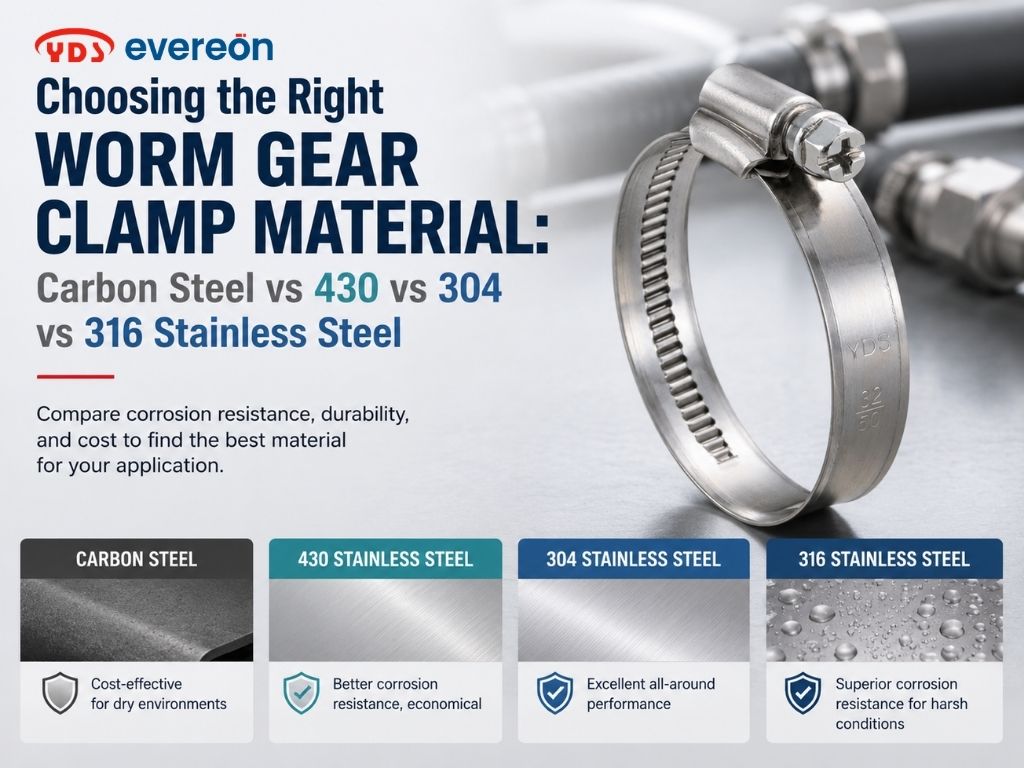
The material of a hose clamp directly affects its durability, corrosion resistance, and suitability for different environments. Selecting the appropriate material is essential to ensure long-term performance and prevent premature failure.
Common material options include:
In some clamp designs, different components such as the band, housing, and screw may use different material grades to balance performance and cost.
When selecting a hose clamp material, it is important to evaluate the operating environment:
In most industrial and export applications, stainless steel hose clamps are recommended due to their balance of durability, corrosion resistance, and reliability.
The structural design of a hose clamp plays a critical role in determining its clamping force, sealing reliability, and long-term performance. Different designs vary in how they apply pressure, respond to vibration, and accommodate temperature changes or hose deformation.
Understanding these structural differences allows engineers and buyers to select the most suitable clamp type for their specific application.
Worm Gear Clamps
Worm gear clamps are the most widely used type due to their adjustability and ease of installation. A screw mechanism engages with the band to tighten the clamp around the hose.
They can be categorized based on band structure:
These clamps are commonly used in general industrial, automotive, and fluid transfer systems.
T-Bolt Clamps (High Torque Clamps)
T-bolt clamps are designed for applications that require higher clamping force and greater structural stability.
They provide:
They are typically used in heavy-duty industrial applications and automotive systems such as turbocharging.
Ear Clamps (Pinch Clamps)
Ear clamps create a secure seal by compressing a designated section during installation, resulting in uniform pressure around the hose.
Their characteristics include:
Because they are generally not reusable, they are often used in applications where long-term sealing consistency is more important than adjustability.
Spring Clamps (Constant Tension Clamps)
Spring clamps are designed to maintain consistent clamping force by automatically compensating for thermal expansion and contraction.
They are particularly suitable for:
Wire Clamps
Wire clamps are simple, cost-effective solutions typically used in light-duty applications.
They offer:
They are generally suitable for low-pressure systems or temporary connections.
Specialized and Heavy-Duty Designs
In more demanding environments, specialized clamp designs may be required. These can include reinforced bands, multi-bolt configurations, or application-specific geometries.
Such designs are typically used when:
| Type | Advantages | Limitations | Applications |
|---|---|---|---|
| Worm Gear Clamp | Adjustable, easy to install | Moderate clamping force | General industrial |
| T-Bolt Clamp | High strength, durable | Less flexible sizing | High-pressure systems |
| Ear Clamp | Uniform pressure | Not reusable | Fixed / OEM applications |
| Spring Clamp | Constant tension | Limited adjustability | Automotive cooling systems |
| Wire Clamp | Low cost | Low strength | Light-duty use |
Choosing the correct hose clamp depends on several important factors:
While many clamp types exist, worm gear clamps, T-bolt clamps, and ear clamps remain the most widely used in industrial applications due to their versatility and reliability.
Based on the structural and material considerations discussed above, selecting the right hose clamp requires balancing performance, durability, and application conditions.
At EVEREON, we specialize in manufacturing high-quality hose clamps for a wide range of industrial applications. Our product range includes worm gear clamps, high torque clamps, heavy-duty clamps, and pinch ear clamps for rubber pipe fixing and automotive applications.
With strong material control, consistent production quality, and OEM/ODM capabilities, we support our customers in achieving stable, long-lasting hose connections across various industries.
What type of hose clamp is best for high-pressure applications?
T-bolt clamps are generally the best choice due to their high clamping force and durability.
When should stainless steel clamps be used?
Stainless steel is recommended for environments with moisture, chemicals, or outdoor exposure.
Are worm gear clamps suitable for all applications?
They are suitable for most general applications, but high-pressure systems may require stronger clamp types.
What is the advantage of spring clamps?
Spring clamps maintain consistent tension and adapt to temperature changes, reducing the need for retightening.
Selecting the right hose clamp is essential for ensuring system reliability, safety, and efficiency. By understanding clamp types, material options, and application requirements, engineers and buyers can make more informed decisions and reduce long-term maintenance risks.
At EVEREON, we provide a wide range of industrial-grade hose clamp solutions along with customization support. Contact us today to find the most suitable clamp for your application.