2026-09-01
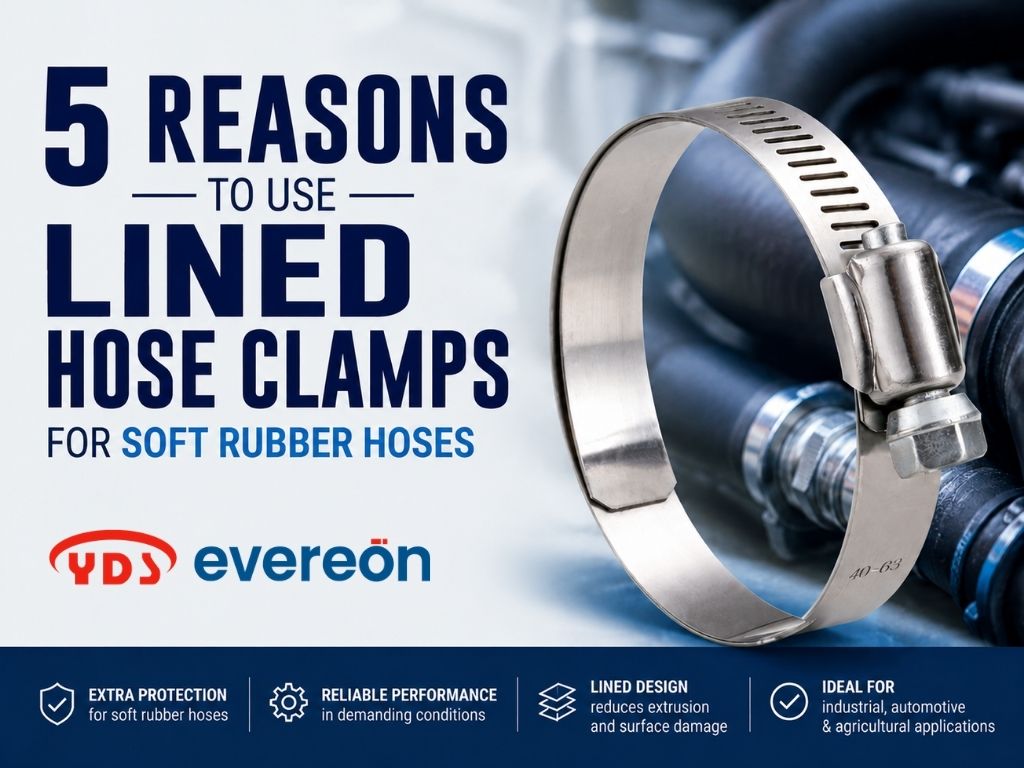
Soft rubber hoses are widely used in automotive systems, industrial machinery, agricultural equipment, and other applications where flexibility is required. However, the same flexibility that makes a soft hose useful can also make its surface more vulnerable during clamping.
A standard perforated worm drive hose clamp provides convenient and reliable fastening, but when tightening pressure is applied directly to a softer hose, the hose material may deform into the perforations in the clamp band. Under unsuitable conditions, this can contribute to surface marking, extrusion, or localized damage.
Lined hose clamps address this issue by adding a smooth liner between the perforated band and the hose surface. The liner allows the clamp to retain the practical advantages of a worm drive design while providing an additional layer of protection for softer hose materials.
So, when should you consider using a lined hose clamp instead of a standard clamp? Here are five important reasons.
A lined hose clamp places an additional liner between the perforated clamp band and the hose, creating a smoother contact surface and preventing the soft hose material from directly entering the band perforations.
This is particularly useful with softer rubber hoses that can deform more easily under tightening pressure.
In a conventional American-type worm drive clamp, the perforated band provides flexibility, easy installation, and reliable tightening. With a lined design, the liner covers the perforated surface on the inside of the clamp where it contacts the hose.
This relatively simple structural difference can make an important difference when hose protection is a priority.
One of the primary reasons to use a lined hose clamp is to reduce hose extrusion through the perforated band.
A perforated worm drive clamp contains openings that engage with the screw mechanism. This design is widely used because it provides convenient adjustment and reliable tightening.
However, when the clamp is tightened around a soft rubber hose, the hose material can be pushed toward or into these openings.
The softer and more compressible the hose material is, the more important this consideration can become.
A liner creates a barrier between the hose and the perforated band. Instead of the hose surface being directly exposed to individual perforations, it contacts the smoother liner.
This helps reduce localized extrusion during installation and tightening.
Extrusion is not always an immediate failure. A connection may still appear properly secured after installation.
However, unnecessary deformation can affect the hose surface and may become more important when the hose experiences repeated pressure changes, vibration, temperature cycling, or long-term service.
For applications involving relatively soft hoses, reducing this problem at installation can help protect the hose over its service life.
A hose clamp must generate enough clamping force to secure the hose to the fitting, but that force should be applied without unnecessarily damaging the hose.
When a soft hose is tightened directly against a perforated band, localized stress can occur around the perforations and band edges.
Depending on the hose material, clamp size, installation torque, and operating conditions, this can contribute to:
A lined hose clamp provides an additional protective interface between the clamp band and the hose.
The liner does not eliminate the need for correct clamp selection or installation, but it can help reduce direct interaction between the soft hose surface and the perforated band.
This is one of the key reasons EVEREON's lined clamps are designed specifically for soft rubber hose applications.
Clamping performance is not determined only by how tightly a screw can be turned. The way clamping force is transferred to the hose is also important.
A standard perforated band has an intentionally interrupted surface because of its openings.
Adding a liner creates a smoother inner contact surface between the clamp and hose.
The structural difference can be understood simply:
Standard Perforated Clamp
Perforated Band → Hose Surface
Lined Hose Clamp
Perforated Band → Protective Liner → Hose Surface
The liner separates the hose from the perforations, helping protect softer hose surfaces as the clamp is tightened.
This makes lined clamps particularly useful when the application needs the adjustability of a worm drive clamp but also requires additional attention to hose protection.
Not every hose behaves the same way under clamping pressure.
A relatively rigid hose and a very soft, compressible rubber hose can respond differently even when the same clamp design and tightening method are used.
Soft hose materials can be more susceptible to:
For this reason, clamp selection should consider hose characteristics, not simply hose diameter.
A lined hose clamp can be useful when the hose surface requires more protection from the clamp's perforated band.
However, the presence of a liner does not mean that any lined clamp is automatically suitable for every soft hose.
Engineers should still consider the hose material, wall thickness, outside diameter, fitting geometry, operating pressure, temperature, vibration, and installation requirements before making a final selection.
Protecting a soft hose does not necessarily mean giving up the advantages of a traditional worm drive clamp.
Lined hose clamps retain the basic worm drive mechanism and perforated band construction while adding an internal liner.
For example, EVEREON's lined clamps use a 1/2" (12.7 mm) perforated band and 5/16" (7.9 mm) hex-head screw. The perforated band provides adjustability and convenient installation, while the liner protects the rubber hose from direct contact with the perforations.
EVEREON specifies a recommended installation torque of 5.0 Nm (44 lbf-in) for its lined clamp series.
This combination provides several practical characteristics:
This makes lined hose clamps a practical option when an application benefits from the versatility of an American-type worm drive clamp but the hose itself requires additional protection.
The most important difference is not simply whether one clamp is "better" than the other.
The more useful question is:
Does the hose require additional protection from direct contact with a perforated band?
| Factor | Standard Worm Drive Hose Clamp | Lined Hose Clamp |
|---|---|---|
| Band Design | Perforated band | Perforated band with protective liner |
| Direct Contact with Perforations | Yes | Liner separates hose from perforations |
| Hose Surface Protection | Standard | Enhanced for softer hoses |
| Soft Hose Extrusion | Depends on hose and installation | Liner helps reduce extrusion through perforations |
| Adjustability | High | High |
| Typical Selection | General-purpose fastening | Applications requiring additional soft hose protection |
| Installation | Worm drive screw | Worm drive screw |
A standard worm drive hose clamp remains an effective solution for many general-purpose applications. A lined clamp becomes particularly useful when hose softness or surface protection is an important selection factor.
EVEREON's standard Worm Drive Hose Clamps and Lined Clamps both use a 1/2" perforated band and are designed according to SAE J1508, while the lined version adds a protective liner specifically for softer hose applications.
Not all lined hose clamps use exactly the same liner configuration.
EVEREON provides two lined clamp designs:
The Standard Lined Band Type (20700 Series) incorporates a liner to help protect the hose from direct contact with the perforated band while retaining the basic worm drive clamp structure.
The Entire Lined Band Type (20900 Series) extends the lined construction around the clamp's inner circumference, providing more complete separation between the hose and perforated band.
Both designs are intended to help protect soft rubber hoses from extrusion and shearing during tightening.
The appropriate configuration should therefore be selected according to the hose, connection design, and required level of contact protection rather than assuming one design is necessary for every application.
Adding a liner addresses hose protection, but it is only one part of proper clamp selection. Buyers and engineers should evaluate the complete hose connection.
The clamp must have a clamping range that properly matches the hose outside diameter after the hose is installed over the fitting.
A clamp that is too large or too small may not operate within its intended adjustment range.
Consider how easily the hose deforms under pressure.
Softer rubber hoses are one of the primary applications where lined clamps can provide additional protection.
The clamp must be appropriate for the mechanical demands of the connection.
Do not assume that adding a liner automatically makes a clamp suitable for high-pressure applications. Clamp structure, hose design, fitting geometry, and system requirements must all be considered.
Moisture, chemicals, outdoor exposure, salt, and other corrosive conditions can influence material selection.
For applications where corrosion resistance is important, the stainless steel grade and the material configuration of the complete clamp should be evaluated.
The materials used for the band, housing, and screw should be considered—not simply whether the product is generally described as "stainless steel."
EVEREON's lined clamp series includes configurations using AISI 430 stainless steel as well as AISI 304 stainless steel. All-304 versions are also available with AISI 304 stainless steel used for the band, housing, and screw.
For more information about selecting materials according to corrosion conditions, read:
How Stainless Steel Hose Clamps Improve Corrosion Resistance
You can also learn more about material differences in:
Choosing the Right Worm Gear Clamp Material: Carbon Steel vs 430 vs 304 vs 316 Stainless Steel
Over-tightening should not be used to compensate for an incorrectly selected clamp.
Excessive tightening can damage the hose or clamp, while insufficient tightening may fail to provide the required connection security.
Always follow the applicable clamp specification and installation requirements.
EVEREON's lined hose clamps are designed for applications including industrial machinery, agriculture, and automotive equipment, particularly where softer rubber hoses require additional protection from a perforated band.
Industrial equipment can contain flexible hoses used for fluid transfer, cooling, air, and other system functions.
Where relatively soft hose materials are used with adjustable worm drive clamps, a lined design can provide additional protection during fastening.
Agricultural equipment frequently operates under vibration, outdoor exposure, dust, moisture, and changing temperatures.
Where soft rubber hoses are used, selecting the appropriate clamp design and material can help protect the hose while maintaining a secure connection.
Automotive systems use hoses with different materials, diameters, temperatures, pressures, and flexibility characteristics.
Where a soft rubber hose is compatible with a worm drive clamp but requires protection from perforated-band contact, a lined hose clamp may be an appropriate option.
The correct clamp should always be selected according to the requirements of the specific connection rather than by application category alone.
At EVEREON INDUSTRIES, INC., our lined clamps are designed to help protect soft rubber hoses from extrusion and shearing through the perforated band during installation and tightening.
The product uses a 1/2" (12.7 mm) perforated band and is available in both Standard Lined Band and Entire Lined Band configurations.
EVEREON lined clamps are manufactured according to SAE J1508 and comply with RoHS and REACH requirements. Material configurations include 430 stainless steel and 304 stainless steel options, including all-304 stainless steel versions for applications requiring greater corrosion resistance.
Our manufacturing and quality-control processes support consistent clamp dimensions and fastening performance for industrial, automotive, agricultural, and OEM requirements.
For OEMs, equipment manufacturers, distributors, or buyers who need lined hose clamps for a specific hose or operating environment, contact EVEREON to discuss your hose size, material, application, operating conditions, and fastening requirements.
A lined hose clamp should be considered when a soft or easily deformable rubber hose needs additional protection from direct contact with a perforated clamp band.
It can be particularly useful when the hose tends to extrude into band perforations or shows localized surface damage after tightening.
However, hose material, outside diameter, operating pressure, temperature, vibration, fitting design, and installation requirements should also be evaluated before selecting the clamp.
Although the names are similar, they are different types of clamps.
A lined hose clamp uses a worm drive mechanism with a protective liner between the perforated band and the hose. Its primary purpose is to secure the hose to a fitting while protecting softer hose material from direct contact with the perforations.
A rubber-lined P-clamp, by comparison, is generally used to support and secure hoses, pipes, cables, or wiring to a structure. It is primarily a mounting and support component rather than a hose-to-fitting sealing clamp.
No. A liner helps reduce direct interaction between a soft hose and the perforated clamp band, but it cannot compensate for incorrect clamp sizing, excessive tightening, unsuitable hose or fitting combinations, or operating conditions beyond the connection's design limits.
Reliable fastening still depends on selecting the correct clamp size and material, following appropriate installation requirements, and considering the hose, fitting, pressure, temperature, vibration, and operating environment as a complete system.
Soft rubber hoses require careful fastening because their flexibility can make them more susceptible to localized deformation and damage during clamping.
Lined hose clamps provide an additional protective interface between the perforated band and the hose, helping reduce extrusion, shearing, and unwanted surface contact while retaining the adjustability and installation convenience of a worm drive clamp.
The five main reasons to consider a lined hose clamp are:
However, the liner is only one part of a reliable hose connection. Hose material, diameter, clamp size, material configuration, operating environment, pressure, and installation requirements should all be evaluated together.
At EVEREON, we provide Standard Lined Band and Entire Lined Band hose clamp solutions for industrial machinery, agricultural, automotive, and OEM requirements. If you need help selecting a lined hose clamp for a specific soft rubber hose or application, contact our team to discuss your requirements and find the most suitable fastening solution.