2026-10-13
When selecting worm drive hose clamps for industrial machinery, automotive components, agricultural equipment, or OEM assemblies, engineers often begin by comparing clamp diameter, band width, and stainless steel grade.
However, these specifications alone do not provide a complete picture of fastening performance.
Two hose clamps with similar dimensions and materials may behave differently during installation. Differences in screw engagement, manufacturing tolerances, torque performance, and component consistency can affect assembly efficiency and connection reliability.
For engineers and technical buyers, a high-performance worm drive hose clamp should be evaluated through measurable specifications rather than appearance or material grade alone.
This article explains five important specifications to check when comparing worm drive hose clamps, how they relate to practical applications, and what to consider when evaluating a manufacturer.
A high-performance worm drive hose clamp combines appropriate mechanical strength, smooth screw operation, controlled dimensions, suitable materials, and consistent manufacturing quality for its intended application.
A worm drive hose clamp typically consists of a metal band, screw, and housing. Turning the screw engages the band and changes the clamp diameter, allowing the band to tighten around a hose connection.
Although the mechanism is straightforward, fastening performance depends on the interaction between these components.
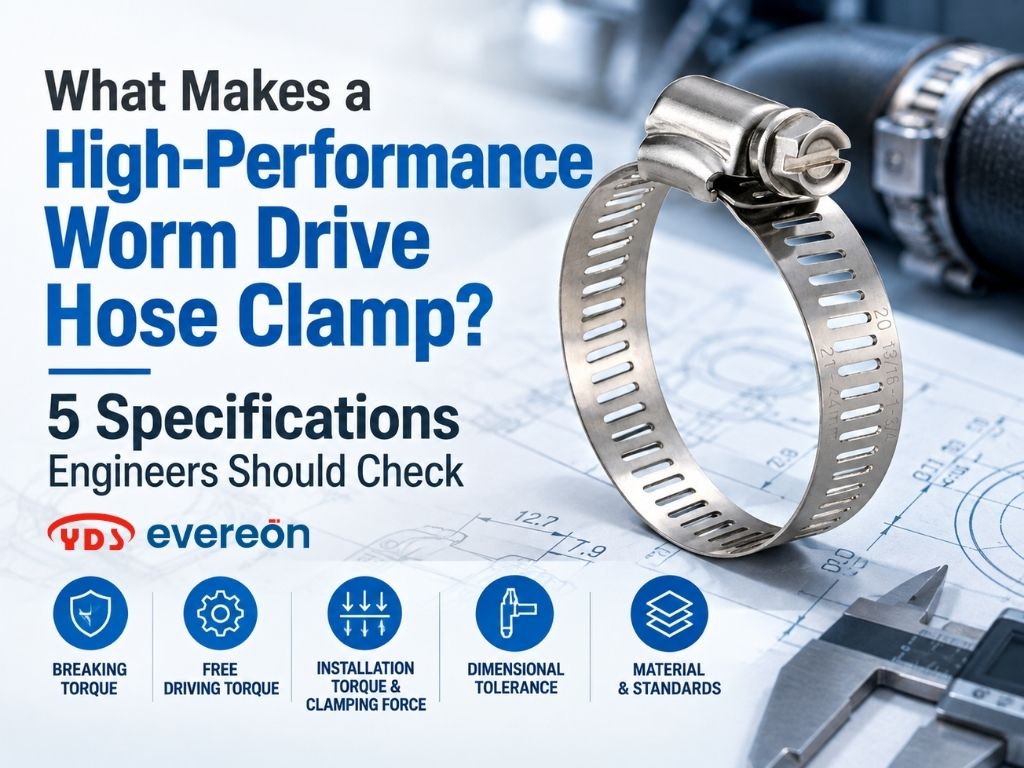
For engineering evaluation, five specifications deserve particular attention:
| Specification | What It Evaluates | Why It Matters |
|---|---|---|
| Breaking Torque | Torque associated with mechanical failure under a defined test | Helps evaluate mechanical strength and resistance to tightening-related failure |
| Free Driving Torque | Torque required to operate the screw before significant clamping resistance develops | Indicates screw operation and assembly characteristics |
| Installation Torque and Clamping Force | Applied tightening torque and resulting compression of the hose connection | Helps assess fastening suitability and installation requirements |
| Dimensional Tolerance | Consistency of band, housing, screw, and clamp dimensions | Supports fit, assembly repeatability, and manufacturing consistency |
| Material and Standards | Material configuration, corrosion resistance, and applicable specifications | Supports application compatibility and quality evaluation |
These specifications should be evaluated together because no single measurement can establish whether a clamp is suitable for every operating condition.
Breaking torque is the torque measured when a clamp or one of its components reaches a defined mechanical failure condition during testing.
It is an important indicator when evaluating the mechanical strength of a worm drive hose clamp.
During installation, tightening torque creates mechanical loads on the screw, housing, and band.
If excessive torque is applied, potential failure modes may include:
Breaking torque testing helps manufacturers assess the strength of the clamp assembly under defined conditions.
For engineers comparing products, the measurement can provide useful information about the clamp's mechanical limits.
Not necessarily.
A higher breaking torque indicates that a clamp can withstand a greater applied torque before reaching the tested failure condition. However, it does not automatically mean that the clamp generates greater clamping force at a specified installation torque.
Actual connection performance also depends on clamp geometry, friction, hose compressibility, fitting design, and installation conditions.
Breaking torque should not be confused with recommended installation torque or maximum system pressure.
When reviewing breaking torque specifications, confirm the test method, acceptance criteria, clamp size, material configuration, and reported units.
For applications requiring additional mechanical strength, engineers may also evaluate dedicated high-torque clamp designs rather than assuming that all standard worm drive clamps have equivalent capabilities.
Free driving torque is the torque required to turn the clamp screw during adjustment before substantial resistance from clamping the hose is introduced.
This specification is particularly relevant to assembly efficiency and screw engagement.
In a worm drive hose clamp, the screw must engage the band perforations smoothly as the clamp diameter changes.
Excessive resistance during adjustment may indicate friction, interference, dimensional inconsistency, or other engagement issues.
For assembly operations, controlled free driving torque can support:
These characteristics can be especially relevant when clamps are installed in large quantities.
Not automatically.
Low free driving torque is desirable when it reflects smooth, controlled engagement. However, it should not be considered independently of screw engagement strength and the clamp's mechanical integrity.
An appropriate clamp should provide smooth operation while maintaining reliable interaction between the screw and band.
Rather than relying only on descriptions such as smooth tightening or easy installation, engineers should determine whether the manufacturer performs free driving torque inspections and maintains consistent acceptance criteria.
For OEM assembly processes, sample evaluation under the intended installation conditions is also useful.
Installation torque is the rotational force applied to tighten the clamp screw, while clamping force is the resulting compressive action applied around the hose connection. They are related, but they are not interchangeable measurements.
This distinction is essential when evaluating worm drive hose clamps for demanding applications.
As the screw is tightened, the band diameter decreases and compresses the hose against the fitting.
However, not all applied torque is converted directly into useful clamping force.
Some energy is consumed by friction and deformation within the screw, band, housing, and hose connection.
Therefore, two clamp designs tightened to the same torque may not necessarily generate identical clamping conditions.
Insufficient tightening may result in inadequate compression of the hose connection, potentially contributing to leakage or movement.
Excessive tightening may cause:
The appropriate installation torque depends on the clamp design and the hose-and-fitting assembly.
No.
Pressure capability depends on the complete hose assembly, including the hose material, fitting geometry, operating temperature, pressure cycling, and clamp arrangement.
A clamp with greater mechanical strength is not automatically suitable for every high-pressure connection.
Engineers should confirm the manufacturer's recommended installation torque for the specific product series and evaluate the complete connection under its intended operating conditions.
When necessary, assembly testing should include leakage, pressure, vibration, or temperature cycling evaluations appropriate to the application.
Dimensional tolerance determines how consistently the clamp's components are manufactured within specified limits. Accurate dimensions help the screw, band, and housing work together as intended.
Even when two hose clamps share the same nominal size, differences in component dimensions may affect adjustment, installation, and assembly consistency.
Important dimensions and characteristics include:
The tolerance requirements should be established according to the applicable product standard, manufacturer specifications, and application needs.
In repetitive manufacturing environments, dimensional variation may affect how smoothly a clamp adjusts or how consistently it fits the intended connection.
Controlled dimensions can help reduce unexpected interference, improve assembly repeatability, and support more predictable installation.
However, tight tolerances alone do not guarantee greater clamping force or higher breaking torque. These performance characteristics still require appropriate testing.
When comparing manufacturers, engineers should look for documented dimensional inspection procedures, defined tolerances, and consistent production controls.
For OEM applications, first article inspection and production sampling can help verify that manufactured components meet the agreed requirements.
Material selection determines how well a hose clamp resists corrosion and suits its operating environment, while industry standards establish requirements and evaluation criteria for particular clamp designs.
For worm drive hose clamps, engineers should consider both the material configuration and the applicable standard.
Common material configurations include:
| Material Configuration | General Characteristics | Selection Considerations |
|---|---|---|
| AISI 430 Stainless Steel Components | Ferritic stainless steel with corrosion resistance suitable for certain moderate environments | Evaluate moisture, chemicals, and environmental exposure |
| AISI 304 Stainless Steel Components | Austenitic stainless steel offering broader general-purpose corrosion resistance | Often considered for industrial and outdoor applications |
| AISI 316 Stainless Steel Components | Austenitic stainless steel containing molybdenum for improved resistance to certain chloride-related corrosion conditions | Consider for more demanding environments after compatibility assessment |
| Stainless Steel Band with Plated Carbon Steel Screw | Combines stainless steel band construction with a different screw material | Evaluate the corrosion resistance of the complete assembly, especially the screw |
The material grade alone does not establish mechanical performance.
For example, choosing AISI 316 instead of AISI 304 does not automatically mean a clamp will provide greater breaking torque or clamping force.
Material configuration, component design, manufacturing quality, and test results must all be considered.
SAE J1508 is an industry specification associated with hose clamp designs and requirements.
For American-type worm drive hose clamps, it provides an important reference when comparing products intended for relevant applications.
However, engineers should confirm the applicable clamp type and requirements rather than assuming that every SAE J1508 clamp has identical torque performance.
EVEREON's Worm Drive Hose Clamps are produced in accordance with SAE J1508. The company's separate High Torque Clamp range includes designs produced according to SAE J1508 Type F.
No.
ISO 9001 concerns the manufacturer's quality management system. It does not, by itself, certify a particular clamp's breaking torque, clamping force, or suitability for a specific hose connection.
Nevertheless, a documented quality management system is valuable when assessing a manufacturer's ability to control processes, inspect products, and maintain production consistency.
Engineers should therefore evaluate ISO 9001 alongside product-specific specifications and inspection records.
Selecting a suitable worm drive hose clamp requires evaluating the complete application rather than choosing the product with the highest advertised torque value.
The following checklist can help engineers and technical buyers structure their evaluation.
| Evaluation Item | Questions to Ask the Manufacturer |
|---|---|
| Breaking Torque | What test method and acceptance criteria are used? |
| Free Driving Torque | Is screw operation inspected for consistent adjustment? |
| Installation Torque | What tightening torque is recommended for this exact product series? |
| Clamping Force | Is application-specific performance data or assembly validation available? |
| Dimensional Tolerance | Which dimensions are controlled and inspected? |
| Material Configuration | What materials are used for the band, housing, and screw? |
| Industry Standards | Which standard and clamp type apply to the product? |
| Quality Control | What inspections are performed during production? |
| Application Compatibility | Has the hose-and-fitting assembly been evaluated under actual operating conditions? |
A clamp that performs well in a mechanical test may behave differently when installed on a particular hose and fitting.
Hose hardness, fitting geometry, temperature changes, vibration, pressure cycling, and installation procedures can influence connection performance.
For critical applications, product specifications should be supplemented with appropriate assembly testing.
This approach is especially important when selecting clamps for automotive, industrial, or other equipment where connection failure could cause significant operational problems.
Consistent hose clamp performance depends not only on the product design but also on the manufacturer's ability to control material quality, component dimensions, assembly, and inspection.
A well-designed clamp can still exhibit performance variation if manufacturing processes are inconsistent.
For OEM buyers and engineers, evaluating a supplier's quality-control system is therefore an important part of product selection.
Depending on the product and customer requirements, relevant procedures may include:
EVEREON's official quality-control information identifies Raw Material Test (RMT), Incoming Quality Control (IQC), First Article Inspection (FAI), In-Process Quality Control (IPQC), Final Quality Control (FQC), and Outgoing Quality Control (OQC).
Our inspection equipment also includes a Vickers Hardness Tester, Image Measuring Instrument, and Torque Wrench Tester. The Torque Wrench Tester is used for free driving torque and breaking torque inspection.
These inspection activities support the evaluation of material characteristics, dimensional consistency, and mechanical performance.
At EVEREON INDUSTRIES, INC., we manufacture worm drive hose clamps in Taiwan for industrial machinery, automotive, agricultural, plumbing, and other fastening applications.
Our product range includes standard worm drive hose clamps and dedicated high-torque designs, allowing customers to evaluate different fastening solutions according to their installation and operating requirements.
Our standard Worm Drive Hose Clamps feature a 1/2" (12.7 mm) perforated band and 5/16" (7.9 mm) hex-head screw.
Available configurations include stainless steel and mixed-material assemblies, with all-304 and all-316 stainless steel options. The product is designed according to SAE J1508.
Explore EVEREON Worm Drive Hose Clamps →
For applications requiring a higher tightening-torque capability, our High Torque Clamps feature a reinforced construction designed according to SAE J1508 Type F.
EVEREON offers 1/2" (12.7 mm) and 9/16" (14.2 mm) band-width versions.
For the specified 1/2" carbon-steel-screw and all-304 series, the published recommended installation torque is 10.0 Nm (88 lbf-in). This value must not be applied indiscriminately to other clamp series.
Explore EVEREON High Torque Clamps →
As a Taiwan hose clamp manufacturer, we combine product engineering with manufacturing and quality-control processes.
Our capabilities include:
Our published production capacity is approximately five million hose clamps per month, supported by manufacturing management systems and in-house engineering capabilities.
For engineering teams and OEM buyers evaluating worm drive hose clamps, we can discuss product dimensions, material configurations, application conditions, and relevant fastening requirements.
Looking for a Taiwan worm drive hose clamp manufacturer? Explore our Worm Drive Hose Clamps or contact EVEREON to discuss your technical specifications and sourcing requirements.
No. Breaking torque relates to a defined mechanical failure condition during testing, while recommended installation torque is the tightening torque specified for installing a particular clamp.
A higher breaking torque does not mean the clamp should be tightened to that value.
Free driving torque helps engineers evaluate how smoothly the clamp screw operates before substantial hose-clamping resistance develops.
Consistent screw operation can support predictable manual or automated assembly. However, assembly suitability should be verified through testing under the intended installation conditions.
No. SAE J1508 provides requirements for relevant hose clamp types, but suitability for a high-pressure application depends on the complete hose connection.
Engineers must also evaluate the hose, fitting, clamp design, installation procedure, pressure conditions, and applicable system requirements.
Useful information includes the hose outside diameter, required clamping range, hose and fitting materials, operating pressure and temperature, vibration exposure, corrosion environment, desired material configuration, installation requirements, and expected order quantity.
These details help manufacturers assess whether an existing clamp design is appropriate or whether customization should be considered.
A high-performance worm drive hose clamp should be evaluated through more than its nominal diameter, band width, or stainless steel grade.
Five specifications are particularly useful for engineering evaluation:
These factors work together, but none should be considered a substitute for validating the complete hose connection.
At EVEREON INDUSTRIES, INC., we support industrial and OEM customers with worm drive hose clamp solutions, quality-control processes, material options, and manufacturing capabilities designed to meet different fastening requirements.
If you are looking for precision worm drive hose clamps, high-torque fastening solutions, or a reliable Taiwan hose clamp manufacturer, contact EVEREON to discuss your application and technical requirements.