2026-08-10
Hose clamps are often installed in environments where moisture, chemicals, salt, temperature changes, and other corrosive conditions are unavoidable. Over time, corrosion can weaken a clamp, affect its ability to maintain clamping force, and eventually increase the risk of leakage or connection failure.
For this reason, stainless steel hose clamps are widely used in automotive, industrial machinery, marine, HVAC, plumbing, agriculture, and other applications where long-term durability is important.
At EVEREON INDUSTRIES, INC., material selection is an important part of hose clamp manufacturing and application planning. Different stainless steel grades provide different levels of corrosion resistance, and choosing a material that matches the actual operating environment can help extend clamp service life and improve connection reliability.
This guide explains how stainless steel improves corrosion resistance, compares common 430, 304, and 316 stainless steel grades, and outlines the key factors engineers and buyers should consider when selecting corrosion-resistant hose clamps.
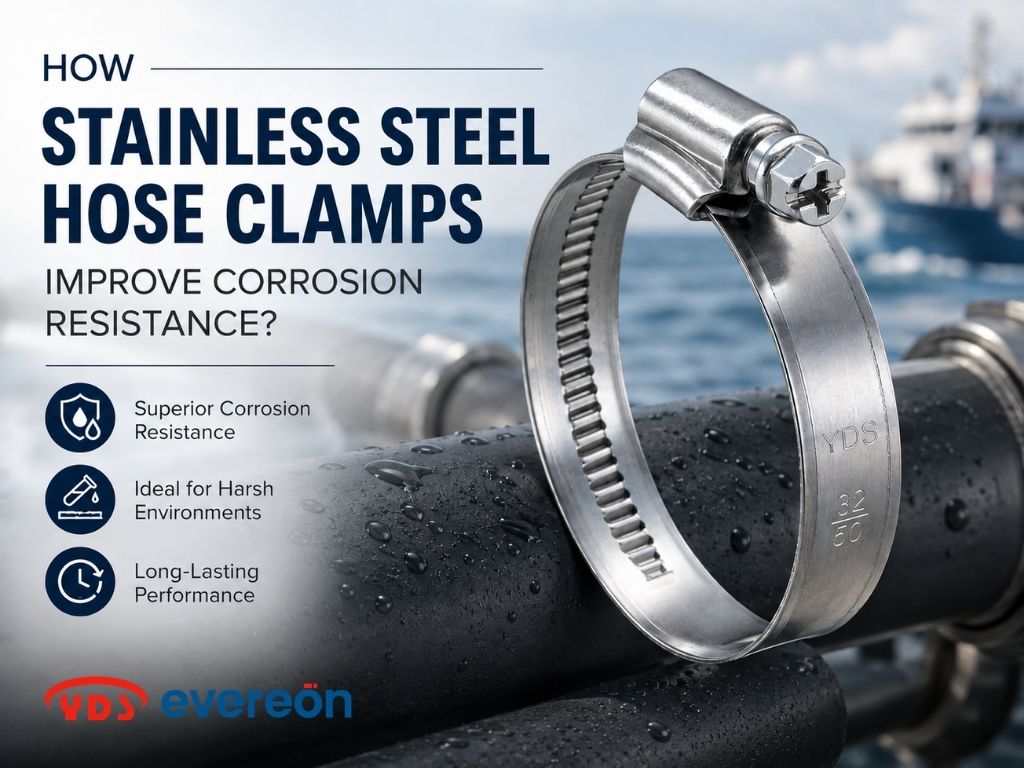
Stainless steel hose clamps resist corrosion because chromium in the steel forms a thin protective passive layer on the surface, helping protect the underlying metal from moisture and oxidation.
However, not all stainless steel grades provide the same protection. 430 stainless steel can be suitable for mild environments, 304 stainless steel provides a versatile balance for many general industrial applications, while 316 stainless steel offers improved resistance to chloride-related corrosion and is often selected for marine, coastal, and other demanding environments.
A hose clamp relies on mechanical tension to maintain contact between the hose and fitting. When corrosion attacks the clamp, the problem goes beyond appearance.
Progressive corrosion can affect several parts of the clamp, including:
As material deterioration becomes more severe, the clamp may become difficult to adjust, lose structural integrity, or become less capable of maintaining the intended clamping force.
In critical applications, this can contribute to fluid leakage, air leakage, hose movement, increased maintenance requirements, or premature component replacement.
Corrosion resistance should therefore be considered as part of the overall hose connection design, rather than simply as a cosmetic requirement.
The primary reason stainless steel offers better corrosion resistance than ordinary carbon steel is its chromium content.
When chromium in stainless steel is exposed to oxygen, a very thin chromium-rich oxide film forms naturally on the surface. This is commonly referred to as the passive layer.
This passive layer acts as a barrier between the underlying metal and the surrounding environment. If minor surface damage occurs, the protective film can reform when suitable conditions and sufficient oxygen are available.
This passive behavior gives stainless steel its characteristic corrosion resistance.
Stainless steel is corrosion-resistant, not corrosion-proof.
Actual corrosion performance depends on factors such as:
Therefore, simply specifying "stainless steel" is not enough. The appropriate stainless steel grade should be selected according to the actual application.
Carbon steel can provide good mechanical strength and cost efficiency, making it suitable for certain controlled environments. However, without adequate protective treatment, carbon steel is generally more susceptible to oxidation and rust when exposed to moisture.
Stainless steel becomes particularly valuable when hose clamps are expected to operate in humid, outdoor, marine, or other corrosive environments.
| Factor | Carbon Steel | Stainless Steel |
|---|---|---|
| Corrosion Resistance | Limited without protective treatment | Generally higher |
| Humid Environments | Less suitable for prolonged exposure | More suitable depending on grade |
| Outdoor Applications | Requires appropriate protection | 304 or 316 may be considered depending on conditions |
| Marine Applications | Generally not preferred | 316 is often preferred |
| Initial Cost | Lower | Higher |
| Long-Term Maintenance | May require more attention in corrosive environments | Can reduce corrosion-related replacement |
Neither material is automatically the best choice for every application.
For dry and controlled environments, carbon steel may provide a practical and economical solution. In environments involving moisture, salt, chemicals, or long-term outdoor exposure, stainless steel can offer important lifecycle advantages.
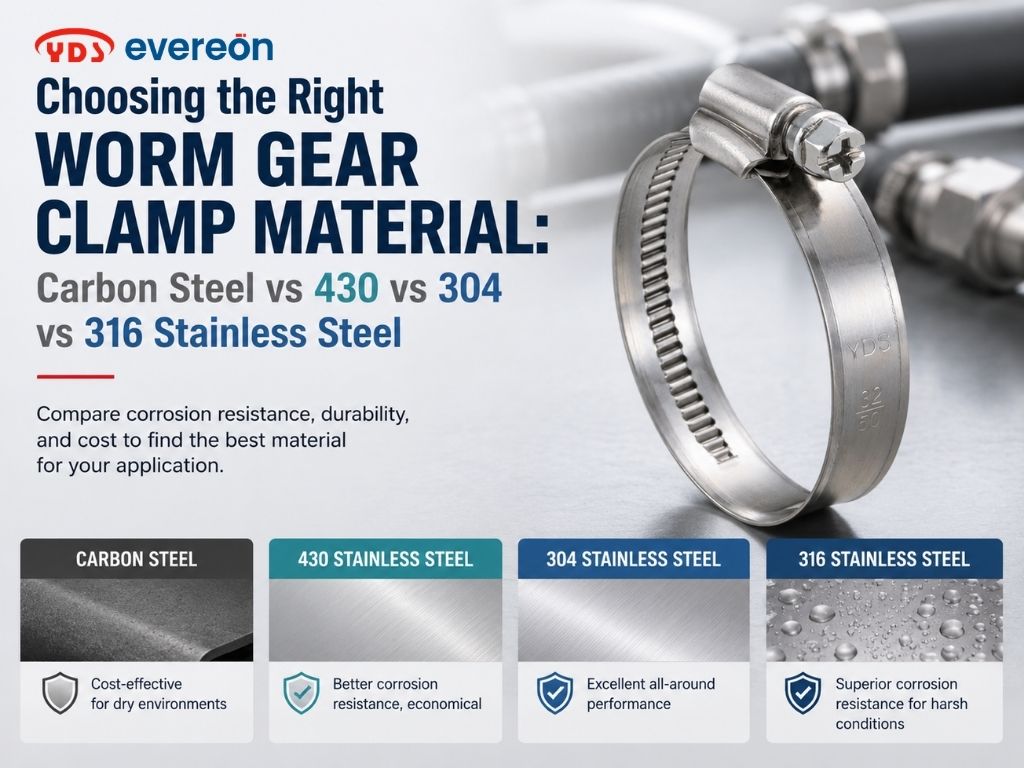
The main difference between 430, 304, and 316 stainless steel hose clamps is their relative corrosion resistance and suitability for different operating environments.
In general:
430 is a ferritic stainless steel that provides moderate corrosion resistance while maintaining good cost efficiency.
It can be considered for:
However, 430 generally provides lower corrosion resistance than 304 and 316, particularly when exposure conditions become more aggressive.
304 stainless steel is widely used in industrial applications because it provides a practical balance of corrosion resistance, mechanical performance, availability, and cost.
Typical applications can include:
For many general-purpose applications, 304 stainless steel provides sufficient corrosion resistance without requiring the higher material cost associated with 316.
316 stainless steel contains molybdenum, which improves resistance to localized corrosion in chloride-containing environments compared with 304.
It is therefore commonly considered for:
When a clamp is regularly exposed to salt, chloride-containing moisture, or certain aggressive chemicals, the additional corrosion resistance provided by 316 can offer an important advantage.
The following table provides a general comparison of common hose clamp materials.
| Material | Relative Corrosion Resistance | Typical Environment | Key Consideration |
|---|---|---|---|
| Carbon Steel | Low | Dry, controlled environments | Economical but requires appropriate corrosion protection |
| 430 Stainless Steel | Moderate | Indoor and mild industrial environments | Balance between cost and corrosion resistance |
| 304 Stainless Steel | High | General industrial, automotive, HVAC and outdoor applications | Versatile option for many applications |
| 316 Stainless Steel | Very High | Marine, coastal and certain chemical environments | Improved resistance to chloride-related corrosion |
Note: These are relative comparisons for general selection guidance rather than standardized corrosion-resistance ratings. Actual performance depends on the specific environment, surface condition, temperature, exposure duration, and chemical concentration.
316 stainless steel is often selected for marine hose clamp applications because its molybdenum content provides improved resistance to localized corrosion caused by chloride exposure compared with 304 stainless steel.
Marine environments are particularly challenging for metal components because seawater and salt spray contain chlorides.
Chlorides can interfere with the protective passive layer on stainless steel and contribute to localized forms of corrosion, including pitting and crevice corrosion.
For this reason, 316 stainless steel is commonly considered for hose clamps used around:
However, 316 should not be interpreted as completely corrosion-proof. Actual performance still depends on exposure conditions, temperature, maintenance, surface condition, and other environmental factors.
A common mistake when evaluating a stainless steel hose clamp is looking only at the material of the band.
A typical hose clamp can contain several components:
Depending on the clamp design and specification, these components may not necessarily be manufactured from the same material grade.
Therefore, for applications where corrosion resistance is particularly important, buyers should evaluate the material specification of the entire clamp assembly, not only the band.
For example, using a highly corrosion-resistant band does not automatically provide the same level of protection if another critical component is made from a material less suitable for the operating environment.
This becomes particularly important in marine, coastal, chemical, outdoor, and other demanding applications.
Material grade alone does not determine the corrosion performance of a hose clamp.
The surface condition of stainless steel and the consistency of the manufacturing process can also influence long-term performance.
Potential factors include:
Proper installation is also important. Excessive tightening, inappropriate tools, or poor clamp positioning can damage the clamp or hose and negatively affect the overall connection.
Therefore, reliable corrosion performance depends on a combination of appropriate material selection, manufacturing consistency, surface condition, and correct installation.
When corrosion resistance is a priority, selecting the highest stainless steel grade is not automatically the most economical or technically appropriate solution.
Instead, evaluate the actual operating conditions.
For dry indoor applications, 430 stainless steel may provide sufficient performance depending on the requirements.
For regular moisture exposure or outdoor applications, 304 stainless steel may be more appropriate.
For marine, coastal, or saltwater environments, 316 stainless steel should be considered because of its improved resistance to chloride-related localized corrosion.
Do not select material based simply on whether an application is described as "chemical."
The specific chemical, concentration, temperature, and exposure duration all influence corrosion behavior. Material compatibility should therefore be evaluated according to the actual process conditions.
A lower-cost material can reduce initial purchasing costs but may require earlier replacement in corrosive environments.
For industrial and OEM projects, evaluating total lifecycle cost may therefore provide a more useful comparison than purchase price alone.
Material is only one part of hose clamp selection.
Band construction, clamp design, hose material, tightening requirements, pressure conditions, and installation environment should also be evaluated.
For more information about clamp structure, read our related article:
This guide explains how band design, clamping characteristics, hose protection, and application requirements influence the selection between German and American type hose clamps.
For buyers who need a quick starting point, the following table summarizes typical material considerations.
| Operating Condition | Typical Material Consideration |
|---|---|
| Dry indoor equipment | Carbon Steel / 430 Stainless Steel |
| General industrial environment | 304 Stainless Steel |
| Outdoor equipment | 304 Stainless Steel |
| High-humidity environment | 304 / 316 Stainless Steel |
| Coastal environment | 316 Stainless Steel |
| Marine / Saltwater exposure | 316 Stainless Steel |
| Chemical exposure | Evaluate specific chemical compatibility; 316 may be appropriate depending on conditions |
These recommendations are intended as general selection guidance, not absolute material specifications. Actual environmental conditions and application requirements should always be evaluated before final material selection.
At EVEREON INDUSTRIES, INC., we understand that reliable hose connections depend on more than simply selecting a stainless steel clamp.
Performance is influenced by the interaction between material, clamp design, manufacturing consistency, installation conditions, and operating environment.
Our hose clamp solutions support a broad range of requirements, including:
Different applications may require different material configurations. EVEREON provides multiple material options to help customers balance corrosion resistance, mechanical performance, service life, and overall cost.
This flexibility is particularly important for industrial and OEM customers. A hose clamp installed on indoor machinery does not necessarily require the same material specification as one continuously exposed to moisture, saltwater, or harsh outdoor conditions.
Rather than applying a one-material-fits-all approach, EVEREON works with customers to evaluate application requirements and select hose clamp solutions that better match their actual operating conditions.
No. Stainless steel is corrosion-resistant rather than completely corrosion-proof. Its performance depends on the stainless steel grade, environmental conditions, chloride exposure, chemicals, temperature, surface condition, and maintenance.
Neither is universally better. 304 stainless steel provides a good balance for many general industrial applications, while 316 provides improved resistance to chloride-related localized corrosion and is often selected for marine and coastal environments.
It depends on the level and duration of environmental exposure. 430 provides moderate corrosion resistance, but 304 or 316 may be more appropriate when the clamp experiences persistent moisture, salt, or other aggressive conditions.
Stainless steel hose clamps can still corrode when exposed to aggressive chemicals, chlorides, contamination, crevice conditions, unsuitable material combinations, or environmental conditions that exceed the capabilities of the selected stainless steel grade.
For highly corrosive environments, the materials used for the band, housing, screw, and other components should all be considered. The corrosion resistance of the complete clamp assembly is more important than the material designation of only one component.
Stainless steel hose clamps improve corrosion resistance primarily through the protective passive layer created by chromium in the material. However, the level of protection varies significantly depending on stainless steel grade and operating environment.
430 stainless steel can provide a cost-effective solution for mild conditions, 304 offers a versatile balance for many general industrial applications, and 316 provides additional protection for chloride-rich, marine, coastal, and other demanding environments.
The most reliable solution is therefore not simply choosing the highest material grade. It is matching the clamp material, design, and complete assembly specification to the actual application.
At EVEREON, we provide hose clamp solutions in different designs and material options to help industrial and OEM customers achieve reliable fastening, appropriate corrosion resistance, and long-term performance. If you are looking for the right hose clamp material or need support for a specific application, contact our team to discuss your requirements and find the most suitable solution.