2026-06-04
When selecting a hose clamp, many engineers and buyers focus primarily on material grade or clamp size. However, the structural design of the clamp can be equally important in determining sealing performance, hose protection, and long-term reliability.
Among the most widely used hose clamp designs are German Type Hose Clamps and American Type Hose Clamps. While both utilize a worm-drive tightening mechanism, they differ significantly in band construction, pressure distribution, torque characteristics, and application suitability.
At EVEREON INDUSTRIES, INC., we frequently help customers evaluate which hose clamp design best fits their operating conditions. Understanding the differences between German and American type hose clamps can help reduce leakage risks, improve hose life, and optimize overall system performance.
Before examining the differences, it is important to understand their similarities.
Both clamp types:
The primary distinction lies in the design of the band and housing, which directly influences clamping force distribution and hose protection.
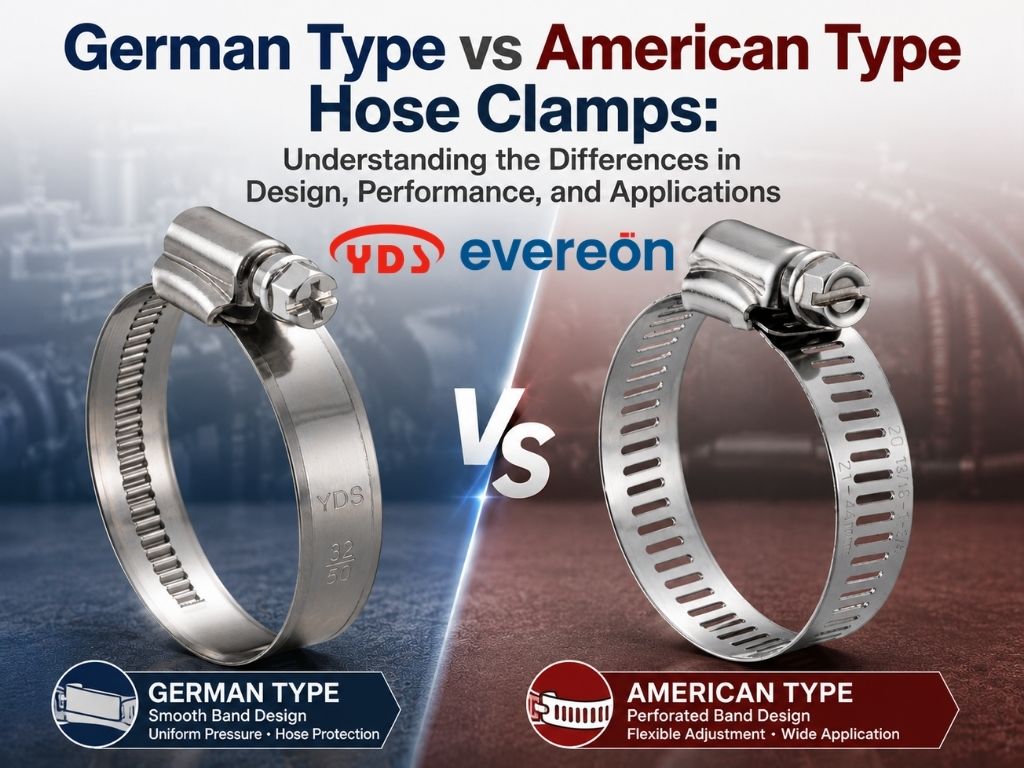
The most recognizable difference between German and American type hose clamps is the band construction.
German type hose clamps typically feature a smooth inner band. The screw housing is designed so that the tightening mechanism does not create perforations through the entire band surface that contacts the hose.
Advantages include:
These characteristics make German type clamps particularly popular in applications where sealing reliability and hose protection are critical.
American type hose clamps commonly utilize a perforated band design, where slots are stamped along the band to engage with the screw.
Advantages include:
Because of their versatility and affordability, American type hose clamps are widely used in general industrial and automotive applications.
The difference in band construction influences how clamping force is transferred to the hose.
German type clamps generally distribute pressure more evenly around the circumference of the hose. This helps minimize localized stress concentrations that can occur when higher tightening torque is applied.
American type clamps provide strong holding capability and flexibility in adjustment. However, under certain conditions, the perforated band design may create concentrated pressure points that require careful torque control, particularly when used with softer hose materials.
For applications involving sensitive hose materials, pressure retention, or long service life, pressure distribution becomes an important consideration during clamp selection.
Many buyers assume that higher tightening torque automatically results in better sealing. In reality, the relationship between torque and sealing performance depends on both the clamp design and the hose material.
German type clamps are often selected when:
Their smooth band construction helps convert tightening force into more uniform circumferential compression.
American type clamps are frequently used when:
Their design offers dependable performance across a wide variety of operating environments.
Regardless of design style, material selection remains a critical factor.
Common material options include:
| Material | Corrosion Resistance | Typical Applications |
|---|---|---|
| Carbon Steel | Basic | Indoor and low-cost applications |
| 430 Stainless Steel | Moderate | General industrial environments |
| 304 Stainless Steel | High | Most industrial and automotive systems |
| 316 Stainless Steel | Very High | Marine, chemical, and coastal environments |
Selecting the correct material is often just as important as choosing the correct clamp design.
For example, a perfectly designed clamp can still fail prematurely if exposed to corrosive conditions beyond the capabilities of its material grade.
German type hose clamps are commonly found in:
These applications often benefit from improved hose protection and consistent sealing performance.
American type hose clamps are widely used in:
Their versatility and cost-effectiveness make them one of the most commonly used hose clamp styles worldwide.
There is no single answer that fits every application.
German type hose clamps are often preferred when:
American type hose clamps are often preferred when:
The best choice ultimately depends on the operating environment, hose material, pressure level, temperature conditions, and maintenance requirements.
At EVEREON INDUSTRIES, INC., we manufacture both German type and American type hose clamps to support diverse industrial requirements.
Our product range includes:
With decades of manufacturing experience, advanced production capabilities, and strict quality control systems, we help customers select the most appropriate hose clamp solutions for their specific applications.
Whether the priority is hose protection, corrosion resistance, vibration performance, or cost optimization, our team works closely with customers to deliver reliable and long-lasting fastening solutions.
Not necessarily. Both designs can provide reliable sealing. The key difference is how clamping force is distributed and how the clamp interacts with the hose material.
German type hose clamps are often preferred because their smooth band design helps reduce the risk of hose surface damage.
Yes. German and American type hose clamps are commonly available in 430, 304, and 316 stainless steel grades.
Absolutely. They are widely used in industrial, automotive, agricultural, and commercial equipment applications worldwide.
Consider factors such as hose material, operating pressure, temperature fluctuations, corrosion exposure, and maintenance requirements when selecting the most suitable design.
Although German type and American type hose clamps share the same worm-drive operating principle, their differences in band construction, pressure distribution, and application suitability can significantly affect performance.
By understanding how each design interacts with different hose materials and operating environments, engineers and buyers can make more informed decisions that improve sealing reliability and extend service life.
At EVEREON, we provide a comprehensive range of hose clamp solutions designed to meet the demands of industrial, automotive, marine, and OEM applications worldwide.