2026-07-08
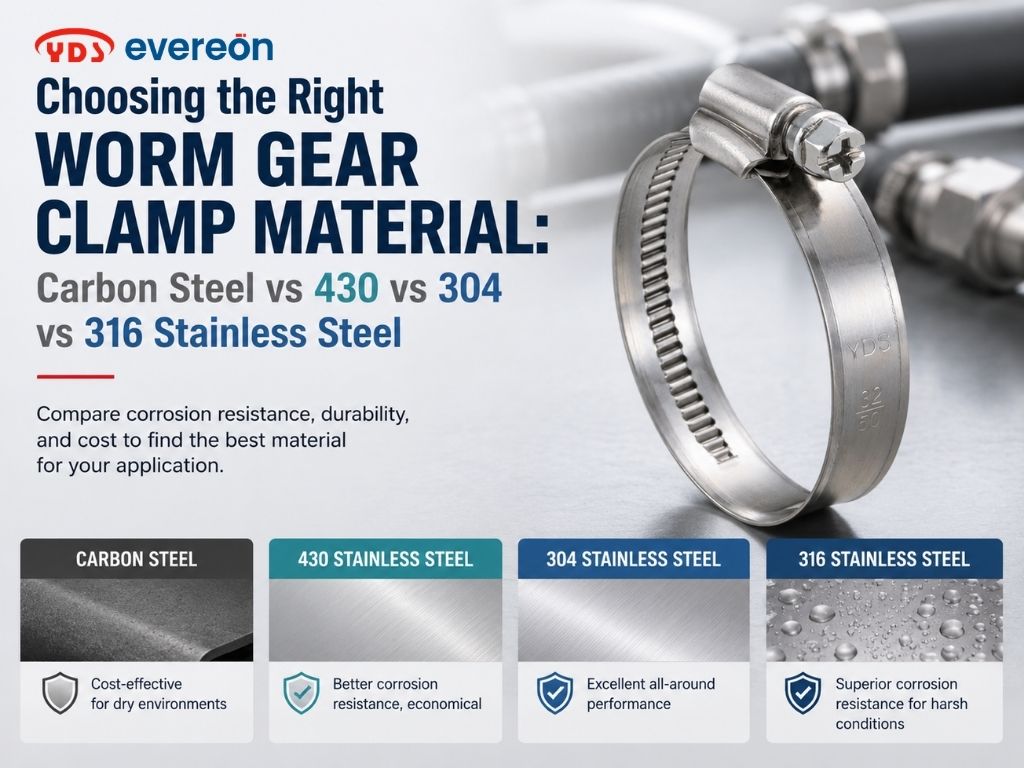
When selecting a worm gear clamp, many buyers focus on clamp size, band design, or tightening performance. While these factors are important, material selection is equally critical because it directly affects corrosion resistance, service life, maintenance costs, and overall system reliability.
Different operating environments expose hose clamps to varying levels of moisture, chemicals, temperature fluctuations, and vibration. Choosing the wrong material may lead to premature corrosion, clamp failure, or unexpected maintenance, even if the clamp itself is properly designed.
At EVEREON INDUSTRIES, INC., we manufacture a wide range of stainless steel hose clamps for customers worldwide. Understanding the characteristics of different materials helps engineers, OEM manufacturers, and purchasing professionals select the most suitable solution for their applications.
A worm gear clamp creates sealing force by compressing a hose against a fitting. If the clamp material deteriorates over time, its ability to maintain consistent clamping force will also decrease.
Choosing the appropriate material helps:
Material selection should therefore be considered together with clamp design, operating pressure, and environmental conditions.
Although worm gear clamps share a similar operating principle, they are manufactured using different materials to meet various application requirements.
Carbon steel is commonly used in cost-sensitive applications where corrosion exposure is minimal.
Advantages
Limitations
Typical applications include indoor machinery, temporary installations, and equipment operating in controlled environments.
430 stainless steel offers improved corrosion resistance compared with carbon steel while maintaining good cost efficiency.
Advantages
Limitations
430 stainless steel is often selected for general industrial equipment and indoor commercial applications.
304 stainless steel is the most commonly used material for industrial worm gear clamps.
Its excellent balance of corrosion resistance, strength, and cost makes it the preferred choice for a wide variety of industries.
Advantages
Typical applications include:
For many applications, 304 stainless steel provides the best balance between performance and overall cost.
316 stainless steel provides the highest level of corrosion resistance among commonly used hose clamp materials.
The addition of molybdenum significantly improves resistance to chlorides, saltwater, and aggressive chemicals.
Advantages
Typical applications include:
Although 316 stainless steel has a higher initial cost, its longer service life often reduces maintenance and replacement expenses over time.
| Material | Corrosion Resistance | Durability | Cost | Recommended Applications |
|---|---|---|---|---|
| Carbon Steel | Low | Good | Low | Indoor equipment, temporary installations |
| 430 Stainless Steel | Moderate | Good | Medium | General industrial environments |
| 304 Stainless Steel | High | Excellent | Medium-High | Automotive, HVAC, machinery, plumbing |
| 316 Stainless Steel | Very High | Excellent | High | Marine, chemical, coastal environments |
| Industry | Recommended Material | Reason |
|---|---|---|
| Automotive | 304 Stainless Steel | Excellent durability and corrosion resistance |
| Industrial Machinery | 304 Stainless Steel | Long service life under general operating conditions |
| Marine | 316 Stainless Steel | Superior resistance to saltwater corrosion |
| Chemical Processing | 316 Stainless Steel | Excellent chemical resistance |
| Agriculture | 430 or 304 Stainless Steel | Suitable for outdoor environments with moderate moisture |
| HVAC | 304 Stainless Steel | Good balance of durability and cost |
| Indoor Commercial Equipment | 430 Stainless Steel | Cost-effective with adequate corrosion resistance |
Selecting the appropriate material according to the operating environment can significantly improve equipment reliability and reduce maintenance costs.
While material plays a major role in hose clamp performance, it should not be considered independently.
Clamp structure, band design, tightening mechanism, and pressure distribution also influence sealing performance and hose protection.
For example, even when two clamps are made from the same grade of stainless steel, differences in band construction may result in different pressure distribution characteristics and application suitability.
To better understand how clamp design affects performance, read our related article: German Type vs American Type Hose Clamps: Understanding the Differences in Design, Performance, and Applications.
At EVEREON INDUSTRIES, INC., we understand that no single material is suitable for every application.
Our hose clamp product range is available in multiple material grades to meet the requirements of different industries and operating environments.
Our solutions include:
Depending on customer requirements, we provide products manufactured with carbon steel, 430 stainless steel, 304 stainless steel, and 316 stainless steel to achieve the optimal balance between performance, durability, and cost.
Supported by advanced manufacturing equipment, strict quality management, and OEM/ODM development capabilities, EVEREON helps customers select fastening solutions that deliver long-term reliability in industrial, automotive, marine, and commercial applications.
Yes. For most industrial, automotive, HVAC, and plumbing applications, 304 stainless steel offers an excellent balance of corrosion resistance, durability, and cost.
316 stainless steel is recommended for marine environments, chemical processing, coastal installations, and applications exposed to high levels of moisture or corrosive substances.
Yes. 430 stainless steel generally provides better corrosion resistance while remaining more economical than 304 stainless steel.
Not necessarily. Material should be selected according to the operating environment. Choosing 316 stainless steel for a dry indoor application may increase costs without providing significant practical benefits.
Selecting the appropriate worm gear clamp material is essential for achieving long-term sealing performance, corrosion resistance, and overall system reliability. Carbon steel, 430 stainless steel, 304 stainless steel, and 316 stainless steel each offer unique advantages depending on the operating environment and application requirements.
By understanding the strengths and limitations of each material, engineers and buyers can make informed decisions that reduce maintenance costs and extend equipment service life.
At EVEREON, we provide a comprehensive range of worm gear hose clamps manufactured in multiple material grades to meet diverse industrial requirements. Whether your application demands cost efficiency, enhanced corrosion resistance, or maximum durability, our team is ready to help you select the most suitable hose clamp solution.